Great By Choice for Nonprofits

I had the opportunity to attend Great by Choice presented by Jeff Johnson.  For those of you who have not read the book, the premise is that,  “We cannot predict the future. But we can create it.”  While the book is intended for business audiences, the success factors described are very applicable to the nonprofit world.

Author, Jim Collins, shares what separates a great leader from an average or even simply good leader?

1. They are not more creative.
2. They are not more visionary.
3. They are not more charismatic.
4. They are not more ambitious.
5. They are not more blessed by luck.
6. They are not more risk seeking.
7. They are not more heroic.
8. They are not more prone to making big, bold moves.

They do share some common qualities, which are:

1. Fanatic Discipline – this is the ability to develop values, purpose, goals, and standards… and then stick to them over a long period of time with minimal variance.

2. Empirical Creativity – which is the process of looking to numbers to verify decisions.  Especially in difficult times it is the norm to look to “experts” or even “standard operating” to seek direction.  Great leaders find creative ways to test outcomes before committing large resources in any direction.  They use empiricism as the foundation for their decisions.

 3. Productive Paranoia – which means to operate as if terribly luck, or unseen competition is just around the corner at all times.  If you knew you were about to head into a horrible market or that a competitor was about to vie for your top clients, what would you do to be prepared?

4. Incredible Ambition – for the organization, not just themselves.

In “Great by Choice” they share an idea of the 20-mile march.  The idea is that, I will push myself to go 20 miles in the worst conditions, and limit myself to only 20 miles in the best conditions.  It is the drive to succeed no matter what comes against me and the discipline to hold reserves even if everything seems to be for me; because I know that conditions change, often without warning, and rarely in my favor.

Fanatic discipline requires the ambition to achieve and the self-control to hold back.  The key is to decide on a 20-mile march, and then reach it every month/quarter/year.  The productivity is linear, but the results are exponential.  A 20-mile march has these characteristics:

1. Clear performance markers

2. Self-imposed restraints

3. Appropriate to the specific enterprise

4. Largely within the company’s control to achieve

5. A proper timeframe, long enough to manage yet short enough to have teeth

6. Imposed by the company itself (not outside agencies)

7. Achieved with high consistency

Some questions to ask if  you develop your own 20-mile march are:

1. What must we accomplish in order to reach our goals and accomplish our vision?

2. What must we conserve to weather future storms?  What does it look like to be over-extended in a particular environment?

3. Are we willing to live with this 20-mile march for the next 15 years?

Empirical Creativity – Fire Bullets, then cannonballs. The goal in empirical creativity is to fire as many small probes as possible before committing large resources to an initiative.  This is called “calibrating” a cannonball.  Innovation, perse, is not the key to success in any industry.  New is not always better, it often depends on how many resources it takes to be new first.  Every industry has an innovation threshold which must be met in order for a company to survive.  But, after that threshold is reached it is much more important to be right than to be first.  And, right is determined by empirical data.

One question to ask as we continue is, “What is the innovation threshold for your industry?  How important is it that you continue to create new things, or are things like price, quality, and customer service more important?”

Quoting Great by Choice, “’Intel Delivers’ explains Intel’s 10x success much better than ‘Intel Innovates.’  Even more accurate, ‘Intel innovates to a necessary threshold, then blows everyone away-utterly, completely, fanatically, obsessively with its ability to deliver on its innovations, at expected cost, with high reliability and great consistency.’”

After deciding the innovation threshold, the next big issue is to use resources in the best, most efficient way.  Think about what signifies a bullet versus a cannonball in your organization.  Bullets have at least three characteristics:

1. Low cost (relative to your budget)

2. Low-risk (even if it completely fails it will not substantially hurt the organization)

3. Low distraction – it may completely distract one or two people, but not the entire organization.

Calibrate your cannonball, then fire.  There comes a time to gather all of your resources and move in a direction.  The important thing is to know, with empirical evidence, that you are calibrated before you fire.  The time always comes to take a large shot; without large shots there is no success.

Productive Paranoia – Leading above the Death Line

The Death Line is that point at which “the enterprise dies outright or becomes so damaged that it can no longer continue with the quest to become an enduring great company.”  There are three main practices that help an organization avoid the death line:

1. Build cash reserves and other buffers to prepare for unexpected events and bad luck before they happen.  The first step here is to identify what your most crucial resources are.  The next step is to stockpile those resources at what will seem an unusual rate; 3-10x your industry.  We do this because we know that the most damaging trials/storms/etc. are those that are unseen, severely strong, and guaranteed to hit.

2. Bound risk – Death line risk, asymmetric risk, uncontrollable risk.  Manage time-bound risk (at what point does your situation change?)  Death Line risk is defined as that risk which could kill or severely damage the enterprise.  Asymmetric means that the potential downside is much larger than the potential upside.  Uncontrollable risks are always present; they must be prepared for.  When it comes to time-bound risks the issue is not just “fast versus slow”.  A better response is “as fast as necessary, as slow as possible”.  The key question is “How much time before our risk profile changes?”  Take all of the time available, increasing vigilance if necessary (meaning, do what you normally do, just more of it) to make the best decision if time is short.  We can never eliminate uncertainty, but can limit it through a combination of good decisions, patience, and vigilance.

3. Zoom out then Zoom in: hyper vigilant to sense changing conditions and respond effectively.  Push for perfect execution of your process, and adjust to changing conditions.  One must be able to see the big picture in order to correctly calibrate short-term decisions.  We should always think and plan before we act, no matter how serious, big, or fast-moving a risk is.  We must also realize that “Not all time in life is equal. Life serves up some moments that count much more than other moments.”

Incredible Ambition – for the organization, not just themselves.  True success must come from a place of greater good.  Ambition for all, not just for one.

Take-away:

1. Get your own copy of this great book at Amazon.com.

2. Think about the four qualities of a great leader.  Are you doing too many events at the sacrifice of quality, are you firing cannonballs for new programs as opposed to bullets, does your nonprofit have cash reserves?  How can you take these qualities and apply them to your world?

Notes credit: Jeff Johnson & the Greater Leander Chamber of Commerce
The Most Fun FREE Nonprofit Tool Ever!!!!

donor expereince

Create Your Own Word Cloud at Tagxedo.

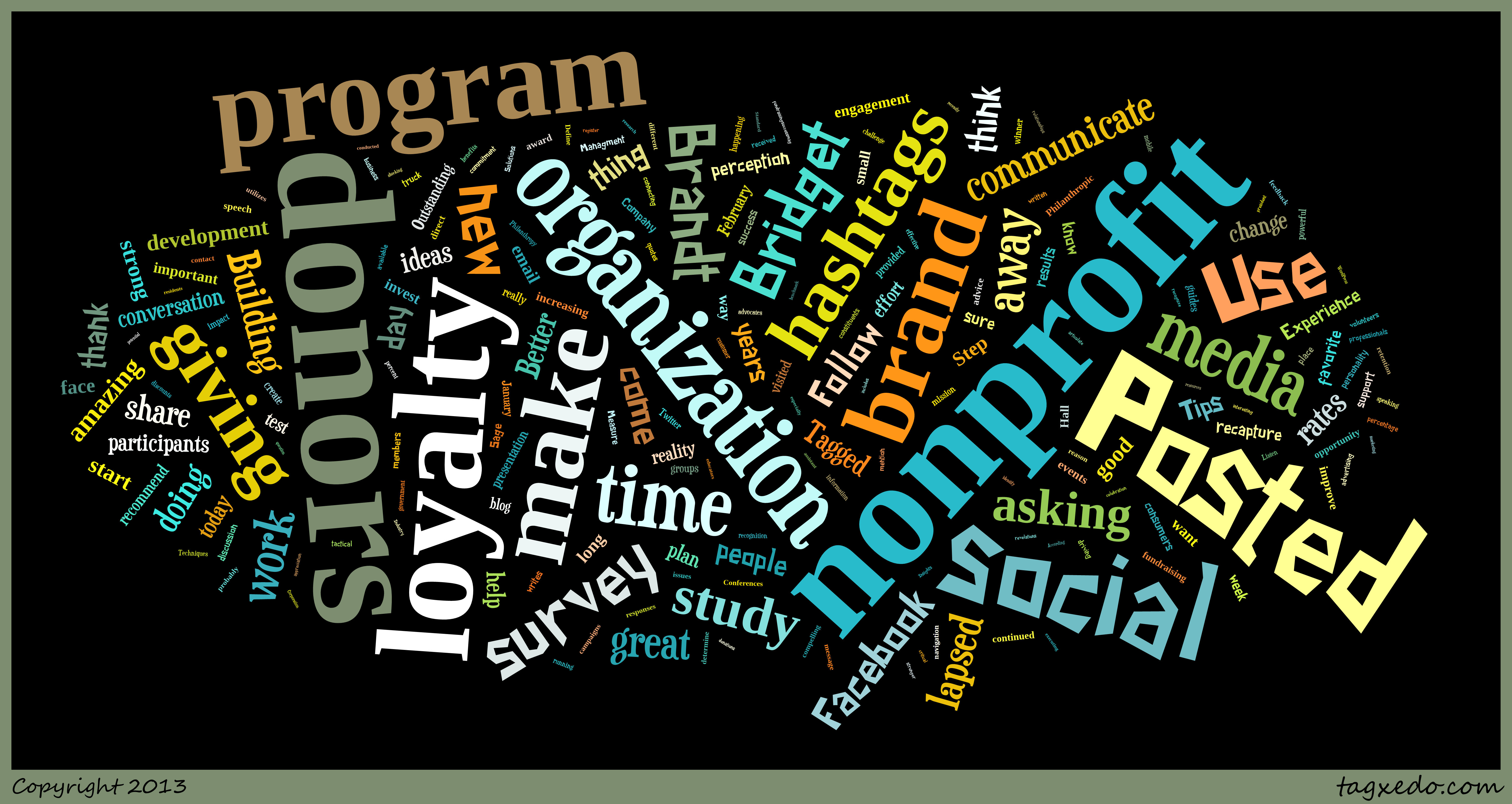
Today I found what might be my favorite tool ever…Tagxedo.  It is a really simple and free tool that allows you to turn speeches, news articles, slogans and themes — into a visually stunning word cloud, words individually sized appropriately to highlight the frequencies of occurrence within the body of text.  This is a great way for nonprofits to get graphics for programs, events, facebook, or just about anything else you can think of.

And, it is simple:

1. Go to http://www.tagxedo.com.

2. Type in your web address.

3. Click on the arrows on the to change the color, theme, shape, or anything else you want to change.

4. Save.

Yes, it really is that easy.

Take-away: Well, obviously…have fun creating your very own word cloud!

Hashtags for Facebook are Here: 3 Tips for How Nonprofits Can Use Them

Facebook is officially unveiling hashtags to its platform. Hashtags, which are hugely popular on Twitter should theoretically make the social media giant more conversational and could have significant search engine optimization implications.


Photo: Getty Images

So, how can your nonprofit benefit from this feature?

1.Discussion: Today hashtags are used to facilitate online discussion.  For example #4changesa uses the hashtag to create conversations about changing the world by giving others the chance to change theirs.  Political groups use hashtags to broadly communicate policy.  Many groups are even using guides to direct followers with “tweeting” points for advocates to use. By adding these same hashtags to Facebook nonprofits have the opportunity to broaden that conversation and help advocates find relevant and important public conversation.

2. Conferences/Events: Hashtags can be used to promote events and event discussion.  They also make it easy for participants to follow the conversation thread and participate whether they are present or just following the conversation from another location.

3. Advertising: You can add hashtags you are already using in advertising campaigns to Facebook to amplify these campaigns.

Facebook said hashtags are now available to a small percentage of consumers and businesses, while it intends to roll them out more widely in the coming weeks.

Take-away: Start adding unique hashtags to your Facebook posts to help increase the reach of your post(s) and conversations.


Perception and Reality

Nonprofits constantly face a challenge of perception versus reality.  This challenge makes it hard for nonprofits to innovate or change because they get caught up in doing what they think is the right thing to do.  I saw this chart and it really got me thinking; is our perception actually our reality?

Perception Versus Reality

Perception Versus Reality

In this chart, consumers rated receiving a discount as the #1 reason they visit companies via social media.  Companies rated discounts as the last reason why consumers visited their social properties.  Pretty compelling!

So, what do we do with that information?  We test!  We make it a part of what we do every day, and we work to actually determine what our donors/constituents/customers need vs. what we think they need.

Lets get tactical:

  1. Survey: Launch a survey in Survey Monkey, Constant Contact, or whatever you are currently using to communicate.  Ask: How can we improve?  How can we better serve you?
  2. Listen:  Really take time to understand what your audience is saying in the survey.  What are they asking for?
  3. Take Action: Make a change (or three) based on the results of the survey.

Take-away: Start testing perception vs. reality in your nonprofit.

Lapsed Donors: How do we get them back?

Last week Sage Nonprofit Solution released their first donor loyalty study of which I had an opportunity to participate in.

First things first: One of my most shocking revelations from the study was that only 29% of nonprofits have a lapsed donor program.  That mistake presents a huge opportunity for others.

If you are one of those organizations that does not want someone to come in and take your lapsed donors, here are a few ideas.

lapsed

Plan: It is important that the efforts expended on your donor recapture program result in revenue for the program.  Make sure you have a clear goal for the program and identify exactly how much is needed to create a positive ROI for the program.  If your program isn’t producing revenue then invest your time in something else.

Identify: Who should you target? Past donors that were true givers (above $20-more than one gift), strong volunteers, or well-known supporters are great targets.  Don’t leave anyone out of your email ask, but make sure you select the most likely candidates for recapture for any direct mail programs.

What: Communicate your message with your lapsed donors clearly and specifically.  Share with them:

  • what you have been doing.
  • the impact your programs are having on the community.
  • the results of your program.
  • what is going to happen if your program goes away.
DON’T call lapsed donors LAPSED or ask them to come back…DO give them a reason to come back!!!

How: After assessing whom you will contact and what you will say, you will need to determine how you plan to communicate with him/her.   Set up a monthly program that includes email, direct mail, and phone calls.  You never know what the trigger for giving again will be or when it will come.  In the early stages of the program, it is critical that you test. Test which variable has the strongest response, test the message that you are sending, and test the frequency of the messages themselves.  Make adjustments often and continue to evaluate the program.

Success: When you successfully recapture a donor, be sure to send a hand-written thank-you note.  I also recommend that following the first gift, you send a very short survey asking how you can improve.  It might reveal why he/she left in the first place.  It will allow you to improve for others and avoid the same mistakes of the past.

Take-away:  Recapturing a donor is time-consuming and difficult.  Invest in a strong program that makes your recapture program less critical, but keep in mind that saving a donor is less expensive than recruiting a new one.

Good Luck with your lapsed donor program!

Donor Loyalty Study, 2013

The 2013 Sage Insights Survey on Donor Loyalty is now available.   The study conducted by Sage Nonprofit Solutions has some very interesting findings that are sure to bring value to any nonprofit organization.Having had the pleasure of being a contributor to the study I was overwhelmed by the number of participants.  Loyalty continues to be a key theme for nonprofits and a driving force for development professionals.

Ironically, the study found that 67% of the people surveyed are not surveying their own donors.  I find it hard to believe that organizations, especially growing ones can reach their full potential without asking how they can get better and what they are doing well.  For me, surveying is always the thing I recommend an organization start with.  Donor/member feedback, should serve as your guiding light.

I was delighted to find that hand written thank-you notes reigned as the king of loyalty.  I have said it before and I will say it again, the value of a hand written thank-you cannot be over exaggerated.

The study goes on to share examples of what organizations are and aren’t doing today to ensure loyalty, and for those of you that penwere wondering, the most utilized give-away was none other than the classic pen.  My guess is the low-cost and  practicality make it the big winner.

In reviewing the study, I was most shocked to find 29% of nonprofits are doing nothing when a donor lapses.  This is good and bad news.  Great news for those of us looking for new donors and bad news for those of us failing to follow-up.

Overall, the study reveals numerous interesting facts and ideas for how your organization can insure that loyalty is a driving force.

Take-away: Check out the full survey, and see what your organization can do to improve loyalty.

Industry Standard Email Rates

I often get this question: How do we know if our email program is good or bad?

The answer varies for everyone, but Eloqua’s Benchmark study is a great place to start.  They recently compared their benchmark data from Jan.-Nov. in an effort to provide you with some guides for click rates, open rates, and click to open rates.  The results can be seen here, and they even separated Nonprofit out.

Email Benchmarks

Take-away: Check your rates and see how you stack up against the Best in Class.

My Favorite Quotes from Philanthropy Day

National Philanthropy Day was first established in 1986.  The celebration is dedicated to those who give tier time, talents, and treasure for the betterment of society.

Today, I had the pleasure of attending the Austin Chapter of AFP’s celebration.  I was moved by the speeches and touched by the amazing work that is happening in our community.

I think that you may agree the people below are simply outstanding.  Here are my favorite quotes from the day:

Outstanding Small Philanthropic Corporation- Fleming’s

Award winner, Darryl Wittle provided a great tip, “Ask people to provide what they are good at and what they do.” And, he closed his speech with some great advice, “always strive to represent something bigger than yourself.”

Outstanding Large Philanthropic Corporation- HEB

Did you know that HEB has been giving back to the communities they serve for 107 years.  Giving back was a part of what they did in the very beginning.  I think that is amazing.  Thank you HEB for that and your amazing motto, “Each and Every Person Counts.”

Outstanding Fundraising Professional

Brett Barnes is the Development Director of Lifeworks, a favorite customer of ours.  His speech today was charming, funny, and kind all at the same time.  His Mom’s advice to him, “Leave the world a better place than when you entered it.”  I ❤ that!

Outstanding Philanthropists

Jeannie and Mickey Klein were grateful when accepting the award today for their generosity.  Mickey borrowed from the late Darryl Royal when saying, “I don’t deserve this, but I don’t deserve arthritis either.”  While Jeannie reminded everyone that the secret to life may just be found in giving back.  “The more you make {giving} a basic part of your life, the more you find the joy, meaning, and satisfaction in living.”

Outstanding Philanthropic Youth

My favorite award of the day, the philanthropic youth award!  I am always amazed and touched by what these winners have done.  The winner this year started giving back at 13, and as a high school student today, he has founded and runs an insanely successful nonprofit.  His speech, love for his mother, and respect for his educators was remarkable.  I can’t wait to see who Brody Roush becomes…maybe President of this great country.

Take-away: I am in awe of the amazing work being conducted by these amazing people.  I hope you enjoy this amazing day and find inspiration to keep doing what you do.  Thank you!

“A small group of committed citizens can change the world, in fact it is the only thing that ever has.”


10 Things Every Organization Should Do to Enhance Donor Loyalty

As published in: http://www.fundraisingsuccessmag.com/article/10-things-every-organization-should-do-enhance-donor-loyalty/2

Developing a solid donor base is not something that happens overnight. It takes time to cultivate a database of constituents who support your mission time and time again, and recommend your organization to others. Many factors are at play in the development of true loyalty, engagement and trust. How your organization utilizes its resources, the impact of your programs and your ability to communicate effectively with donors all factor into the equation and can significantly impact your organization’s ability to earn lasting loyalty.

With the goal of providing you proven, effective methods of increasing donor loyalty, I asked a sample of development professionals for their ideas on this topic. I received dozens of great responses, so thank you to those who provided feedback.

Building an effective program takes time and effort. Here are a few ideas to help you foster the one thing we all desire most, retention.

1. Listen to your donors
Find out what will compel them to further help you achieve your mission. Ask for their advice, and put it to practice.

2. Share your good news
Communication is key to building any relationship, and nonprofit relationships are no different. Think about newsletters, e-mails and face-to-face visits to keep the flow of information open.

3. Measure your success
“In general, donors like to receive regular, measurable and concrete feedback about how their money makes a difference,” says Ursula Pfahl, vice president of business development at Bigham JewelersOpens in a new window, who worked with CMON — The Golisano Children’s Museum of NaplesOpens in a new window. By sharing the impact in real measures, you solidify the good work you are doing.

4. Survey your donors
When Courtney Polster, fund development manager at Agrace HospiceCareOpens in a new window, started surveying her donors, she discovered that a high percentage were utilizing planned-giving vehicles to support a charity — but she was surprised to see how few said hers was their charity of choice for this option. This revelation led to further research. “Quality initiatives like these are helping build a stewardship and recognition program as well as a planned-giving program,” Polster says. “It has been most beneficial!”

5. Leverage donor loyalty

Use your board members to make calls and write thank-you notes. The power of appreciation from a strong board member can go a long way in building loyalty.

6. Involve donor in the cause
By regularly inviting donors to come and see their donations in action, Keith Greer, fundraising and membership coordinator at Popejoy Hall,Opens in a new window has changed the way donors view his organization and increased retention rates by 14 percent and the average donation size by $500. According to Greer, many of Popejoy Hall’s donors always shared the great work of the organization, but with stronger collaboration he has seen a shift in the way donors began talking to their friends after participating in the mission. Now it’s, “Look at what I’m doing to help.” In addition, today he has excited donors asking how they can do more. Greer says that the firsthand experience has “been more powerful for loyalty, engagement and increasing giving than any communication piece we have ever done.”

7. Get social
Create connections in the social networks where your donors spend their time. Connecting socially is very powerful.

According to the 2012 Sage Nonprofit Insights studyOpens in a new window, 84 percent of nonprofits are in social networks, with FacebookOpens in a new window topping the charts. Surprisingly, 69 percent of participants say their organizations are not blogging. Blogging is a great way to keep donors up to date on the status of the organization. Additionally, through social sharing in tools like Facebook and TwitterOpens in a new window, nonprofits can further engage donors and volunteers with those same updates.

8. Customize your approach
“Bottom line: Loyalty comes when we show folks we know them. This means we have to really listen to them. There’s no cookie-cutter approach, as donor preferences vary. We have to be sensitive to our donors’ particular styles, then give them what they want,” says marketing and fundraising consultant Claire AxelradOpens in a new window.

9. Recognize repeat donors
“Whether your organization is new or has been around for years, you can recognize continuous yearly donors in your annual report. Give recognition to donors who have supported you (at a set level) for three years, five years, 10 years — break it down however it works for you — but with recognition, if they have to drop a nonprofit one year, hopefully it won’t be yours!” says CFRE Debbie Joyner.

10. Say thank you
“One easy element is thanking donors for every gift either with a phone call or personalized e-mail. When dealing with loyal donors, I am always sure to mention how long they have been giving and let them know how much their continued support is appreciated. Most donors haven’t thought about how long they have been giving, and I think these small gestures have deepened donor relations with a pretty small investment of my time and our long-distance bill,” says Daniel Blakemore, assistant director for individual giving at International House, New YorkOpens in a new window.

Take-away: Loyalty, retention and engagement seem to be harder to come by these days — probably because we all seem to be running the race faster and faster. True loyalty takes time, effort and commitment to yield fundraising success, but the return is happier donors with a strong commitment to your organization.

Social Media 101

Last week I held a social media session for Habitat For Humanity Central Texas.  What an amazing group of people.  I promised I would share all of the social media tools I have collected.  One of the participants recommended I blog them because as she put it; there are a lot of people who could really use them.

Here are some of my favorite social media tools:

1. Social Media 101: A great presentation introducing social media.

2. From my favorite Social Media Guru, the Marketing Savant a ton of valuable resources can be found here.

3. 50 Social Media Tactics for Nonprofits

4. How the Top 50 Nonprofits Do Social Media

craigsconnect-infographic

Take-away: Get online and start connecting, your donors are in the social sphere and you should probably be there too!