7 No Brainer Grant Tips

This past weekend I had the opportunity to sit on a grant review panel.  It was a wonderful opportunity and an eye-opening experience.  I was blown away by the amazing and the lack luster presentations, as such I feel the need to share some tips.

Next time your organization presents for a grant committee; be one of those that are awarded.

  • BE ON TIME- This one should go without saying, but make sure you complete and submit ALL of the information requested on time.  I am amazed by the sheer number of organizations that get disqualified for this simple reason.
  • BE PREPARED- Bring people who can effectively tell your story and answer questions about your financials.  Nothing is worse than not knowing the answer to a question about your organization.  If the committee asked you to work on a program in prior year’s bring the person that knows about that program.
  • BE CLEAR- State why you are there at the beginning of the presentation.  State what you want.
  • BE EFFICIENT- If you have 10 minutes to speak, use 9 and use them effectively to tell your story.
  • BE PRACTICED- Perfect practice does make perfect.  When you get to a grant panel, it should not be the first time you have told your story.
  • BE RESULTS ORIENTED- When you write a resume, you start with what you have done, do the same for your grant and for the panel.
  • BE PASSIONATE- Show the committee your passion.  Why does this grant matter to you and your organization?

Take-away: Be ready next time you apply for a grant.  Grants require an incredible amount of time to prepare, don’t throw away all of your work in the committee review.

25 Simple Ways to Grow Your Email List Written by Andy Pitre

This is a great post- so I am reposting here because I get this question all of the time.  I really love the idea to add an opt in link to everyone’s email signature.  Enjoy this post!

http://blog.hubspot.com/blog/tabid/6307/bid/32028/25-Clever-Ways-to-Grow-Your-Email-Marketing-List.aspx?utm_campaign=blog-rss-emails&utm_source=hs_email&utm_medium=email&utm_content=16518417

25 Simple Ways to Grow Your Email List

Written by Andy Pitre | @

I have some bad news: Your email marketing database degrades by about 22.5% every yearYour contacts’ email addresses change as they move from one company to another, opt-out of your email communication, or abandon that old AOL address they only use to fill out forms on websites.

As a marketer, it’s your job to make sure you’re constantly adding fresh contacts to your email marketing campaigns so you can keep your numbers moving up and to the right. (But not by purchasing email lists — learn why you should never buy an email list in this post.)

If you’re not working on building your email list already, or you’ve run out of ideas to do so, here are 25 simple ways to grow that email list.

And to learn more about how to build an effective email list, download our ebook about how to optimize your email marketing programs here.

Email List Building: How to Grow Your Email Database for Free

Using Email

1) Create remarkable email content. Your content needs to be amazing if you want people to stay subscribed and forward your emails to their friends, family, and colleagues that aren’t already on your email list.

2) Encourage your current email subscribers to share and forward your emails by includingsocial sharing buttons and an “Email to a Friend” button in your marketing emails. That way, you’ll gain access to fresh networks, friends, and colleagues who might sign up for your list. At the bottom of your emails, include a “Subscribe” CTA as a simple text-based link so that those receiving the forwarded emails can easily opt-in, too.

3) Promote an online contest, like a free giveaway, and have entrants sign up or submit using their email address. (And don’t forget to promote your contest on social!)

4) Create multiple email subscriptions types that you use to send more targeted content to specific segments of your marketing personas. Email recipients are more likely to click through emails that have been targeted at them, so if you create multiple, targeted subscription types, you’ll increase the chance that visitors will subscribe to one of them.

5) Reinvigorate a stale email list with an opt-in campaign. Do you have an older list that you think is mostly decayed? Create an engaging opt-in message and send it to your old list encouraging contacts who wish to re-opt-in and promising to remove all contacts who don’t respond. Though it might seem counterintuitive to remove folks from your email lists in order to grow them, emailing only engaged contacts could improve your deliverability and increase the odds of your email getting shared with those outside your current contacts database.

6) Add a link to your employees’ signatures that leads people to a landing page where they can sign up for your mailing list.

With New Content

7) Create a new lead gen offer — like a free ebook or whitepaper — and require visitors to provide their email address in order to download it. (Need ideas? This blog post lists 23 ways to create lead gen content quickly and easily.)

8) Create a free, online tool, or resource and have users sign up with their email address. For example, we’ve created quite a few free tools, like Marketing Grader, to gather email addresses.

Using Social Media

9) Promote one of your lead-gen offers on Twitter. Create a Twitter campaign to promote an ebook or a free resource to your followers that requires an email address to redeem.

10) Use your Facebook Page to promote an offer that requires an email address submission. Promote offers on your Timeline, and be sure to add social sharing buttons to the landing pages and thank-you pages you send them to so you encourage your leads to share those offers.

11) Add a call-to-action button to the top of your Facebook Business Page, like we did below. Link the CTA button to a landing page that requires an email address for access.

12) Publish links to gated offers on your LinkedIn Company Page or in appropriate and relevant LinkedIn group discussions.

13) Use Pinterest to promote offers that require email sign-up. For example, HubSpot created a Pinterest board where we pin the well-designed covers of our marketing ebooks. From this board, we’ve been able to generate new leads and grow our email list.

14) Leverage your company’s YouTube channel. Add calls-to-action and URLs in your videos to encourage people to subscribe to your list, and include links to relevant landing pages in your videos’ text descriptions.

15) Promote offers and email sign-up through your Google+ Page by making use of your Google+ updates and your Google+ “About” section.

On Your Website

16) Link to offers that capture email signups throughout your website. Don’t make people dig around your site to stumble across subscription options. Keep your offers up front, and include calls-to-action on just about every page of your website. Key places to consider are your website’s homepage, the main page of your blog, your ‘About Us’ page, and your ‘Contact Us’ page.

17) When creating content for guest blogging opportunities, include a call-to-action as well as a link for readers to subscribe to your site’s blog or email database in your author byline.

With a Partner

18) Run a promotion on a partner website or email newsletter that targets a new but appropriate audience to collect email addresses from a fresh source.

19) Host a co-marketing offer with a partner — like an ebook or webinar — and ask them to promote the registration to their audience. After it’s released, swap leads.

With Traditional Marketing/Advertising

20) Collect email addresses at offline events like trade shows and import them into your database. Be sure to send these contacts a welcome email that confirms their opt-in to your list. (See #8 in this blog post for tips on sending welcome emails.)

21) Host your own offline, in-person events like meetups, conferences, hackathons, educational panels, etc., and collect registrations online using email addresses.

22) Encourage prospects in a traditional marketing campaign, like direct mail, to opt in to receive email communications instead. Include a shortened URL with UTM parameters to an online signup, and allow readers to opt out of direct mail. You’ll even save some trees in the process!

23) Host an online webinar and collect email addresses at registration.

24) Leverage paid search ads to link to a landing page with and email sign-up.

25) Add a QR code to your print marketing collateral that people can scan to opt in to your email database.

These are all examples of things you can start doing today to increase your business’ email database. Many of them are not complicated or difficult to implement. The key is to attack email list-building from as many angles as possible. As you grow your email list with fresh, opt-in contacts, you’ll be able to nurture them with middle-of-the-funnel offers that allow you to convert early-stage leads into sales-ready leads.

Editor’s Note: This post was originally published in March 2012 and has been updated for accuracy and comprehensiveness.

Knock It Out of the Park Thank-you Note

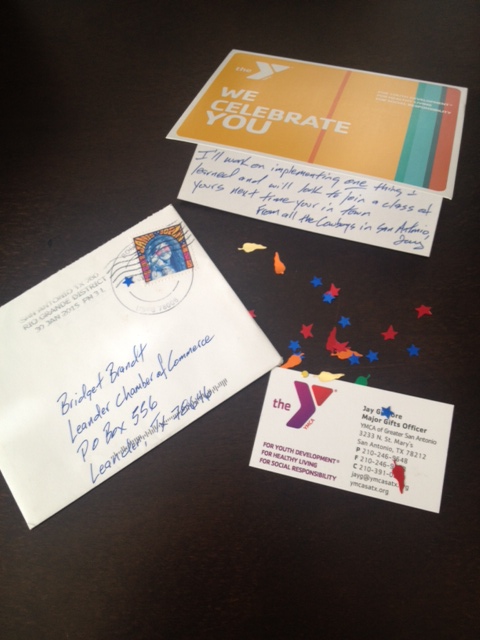
At the end of every single one of my classes I speak to the value of a hand written thank-you.  As such, I get a lot of them. I truly love each and every one.  This one really stood out though, and here is why:

photo

This might be the best thank-you note ever!

1. Every part of it is hand written.

2. It mentioned very specific aspects of our interaction.  It made me feel like Jay was very interested and engaged in our conversation.

3. It was funny, and let’s face it everyone likes to laugh or at least smile.  (Everyone we want in our lives anyway.)

4. It was timely.  I spoke on Thurs. and got this on Monday.

5. It thanked me for my participation in and kind words of the YMCA, and encouraged me to continue to support them without any pressure.

6. MOST IMPORTANTLY- It included confetti!!!  Now, yes it made a mess all over my desk, but that made me smile again…love, love, love this addition to the thank-you.  I will speak about this letter for many years to come.

Take-away: This thank-you makes me want to work with and help the YMCA time and again.  Jay, they should be very thankful they have you on their team.  You truly get it!!!  I wish every nonprofit treated all of their donors the way you treated me today.

Modern Marketing is All About Experience

As I was reading this blog yesterday, I thought well it’s here.  For decades we have talked about how impactful customer experience is and should be. We already know how critical it is in establishing donor relationships, but this article really made me think of how nonprofits should really start making a stronger effort to bring technology into the forefront of what they do and how they deliver services.   It is exciting to see customer experience moving to the forefront in every aspect as we move into the future.

So without further ado, food for thought.

#CES2015 AND SIGNS OF MODERN MARKETING

Posted January 5th, 2015

CES is a monster, 40 years in the making. More than 160,000 people and 3,500 exhibitors are descending upon Las Vegas this week to check out the latest shiny objects at the world’s largest consumer electronics trade show.

And everything CES has become near and dear to our hearts, given our agency work with consumer electronics brands over the years and the challenge of simplifying the complex.

[Attending CES? Remember to gear up with a water bottle, snack bars, Wi-Fi, backup battery, sensible shoes and the CES mobile app.]

welcome-to-fabulous-las-vegas-02

NEW NEW THINGS

This year’s shiny objects include smart homes, 4K TVs, wearables, connected cars and connected home devices. Surrounding the new gadgets is the Internet of Things (IoT) juggernaut, with 900 connected devices (“things”) showcased at CES that communicate without human interaction using IP connectivity. By 2020 this will be a $3 trillion market with more than 30 billion devices, says IDC, changing how we interact with everyday items. Watch for IoT mentions in keynotes from Samsung (Tizen-OS powered TVs), Intel, Ford and Mercedes-Benz.

MODERN MARKETING @ CES

Despite being a product-focused event (by definition), CES also reveals signs of how consumers are changing how they interact with brands and how marketers are taking the steps to become modern marketers and engage audiences in a more personalized, compelling way.

Here are five signs of modern marketing at CES.

1. Customer-Centricity Rules

What is a real estate company doing at CES? With a gazillion new gadgets to connect your home, Coldwell Banker is (rightly) betting that home automation systems, media centers and smart appliances will be big in 2015. They also realize they need to get in front of home buyers early in their decision journey, well before they contact a realtor. For products or services that take more research and consideration (e.g., 4K TVs, cars, home purchases) than impulse buys, nearly two thirds of the purchase decision is made before the customer’s first serious engagement with sales [PDF]. With 22% of Fortune 100 companies staffing a Chief Customer Officer, many brands are making the shift from focusing on product features to customer engagement like MasterCard (see below).

2. Experiences Matter

One of the key mindset shifts for modern marketers is the transition from “campaigns” to “experiences” and planning programs to support ongoing customer engagement as opposed to old-school one-and-done advertising. At CES check out the Brand Matters Program and Michael Donnelly’s (MasterCard) talk on digital disruption and MasterCard’s year of Priceless Surprises – and hopefully some color commentary from the Donnelly Family Digital Lab!

3. Decision Journeys Inform

For the hospitality industry, focusing on extraordinary customer experience is nothing new. But upstarts like Airbnb are pushing established hotel brands to be more creative. To better understand their customer’s holistic experience beyond just finding a room, Airbnb commissioned a Pixar animator to storyboard the entire trip experience frame by frame. The empathetic 30-slide deck reinforced the need to optimize mobile booking and create an Uber-esque car service. At CES look for buzz about keyless entry, temperature control via smartphone, smart rooms that greet you, touch-screen room controls and drone-delivered champagne. Brands are turning to journey mapping exercises to align go-to-market teams and ensure consistent, compelling customer engagement.

4. Omni-Channel Orchestration Unites

A huge challenge for modern marketers is how to consistently engage with an audience across multiple screens, devices and channels. Now that using a second screen while watching TV is the new normal (for 56% of U.S. viewers at least), marketers must rethink how they engage with viewers who tweet, email and otherwise “screen stack” during TV shows. At CES, Samsung adds a twist to the second screen scenario. Going forward, Samsung* revealed that all smart TVs are going to run on its Tizen operating system, ditching their old Android-based smart TV interface. The CES 2nd Screen Summit kicks off Jan 5 in Las Vegas.

*Disclosure: Samsung is an nFusion client.

5. Personalization Connects

It’s been 20 years since Benny Landa predicted that “everything that can be digital will be digital.” Today, the digital customer experience has transitioned from banking and shopping to hailing a car and adjusting your air conditioner, spinning off more datasets and more ways to engage customers. As more and more everyday items are digitally connected, our collective data is mashing it together into online hubs. For brands this is a both a “big data” and “little data” opportunity to personalize what, when and how content gets delivered. While at CES check out the Big Data Revolution in Digital Marketing session to get the latest on marketing cloud platforms from Oracle, Adobe and IBM and how they can orchestrate personalized content and guide decision making.

– See more at: http://nfusion.com/blog/modern-marketing-ces2015/?utm_campaign=nfusion-digital-digest&utm_source=hs_email&utm_medium=email&utm_content=15504590&_hsenc=p2ANqtz-_8hzYTnGQfpf6RpwdXMOvg8qm14YBjPj0wLBDMJCDXOyiOQqTEMqV-8294T3Q2iSo6UjVZ09-F3DcDWlfmPh7auJRYNA&_hsmi=15504590#sthash.jqsahWL4.dpuf

Win Your Year-End Campaign—5 A.S.A.P Steps

This is a great Year-End Campaign Post by Nancy, had to repost for my readers.

Nancy E. Schwartz

Publisher, Getting Attention Blog & E-news

Get Do-It-Today Marketing Guidance from Nancy Schwartz
Delivered Directly to Your Inbox 

Article: Win Your Year-End Campaign—5 A.S.A.P Steps

We’re at the beginning of the endof the year. Now’s the time for you to bear down and give birth to the most compelling fundraising campaign you have in you.

Email outreach is, of course, just one component of your multi-part year-end appeal. But it’s a channel that increases in importance — due to your ability to time receipt precisely — as you move towards the 2014 wind down.


Take a look at the email subject lines above —from December 2013 year-end appeal emails — to get clearer on what will work (and what won’t) for your organization thisDecember.

Keep in mind that your people will (I hope!) have received your year-end asks for a few months by that time, and they’re likely to be feeling some donor fatigue.

Take these steps to finish with a burst (rather than a whimper):
1) Make it personal to match your prospects’ wants and passions. The end of the year is already emotionally weighted with review of the year past and hopes and goals for the year to come. So emphasize that connection (between your organization’s look back and forward with those of your supporters and prospects).

Also, include one of your team’s names (or rotate names) in “from” lines and direct mail signatures (all-year-round recommendation).

2) Motivate, don’t nag. Ringing in the new year with by taking a passionate stand motivates me big time, while nudging me that the clock is ticking just bugs me. I have the same calendar you do!

I ADORE the two subject lines highlighted in yellow above. Both refer to time’s forward momentum, but in the context of the organization’s impact rather than the calendar year. That made sense to me, and I contributed to both organizations.

3) Launch a three- to four-month campaign, starting YESTERDAY (or today, if you haven’t go yet), rather than rely on a late December one off. But make sure to tie all campaign elements together with a single, memorable theme.

Doctors without Borders featured dramatic stories of rescue and relief efforts around the world, from Sudan to Bossangoa, Central African Republic. They crafted their 2013 email series to be so compelling that you couldn’t resist opening each one, like the serial novels of yore. That’s step one to your year-end win.

4) Integrate your email series with your social media channels (where you are already — don’t go out for the first time at this point) AND direct mail (to whomever you send it—based on those who respond).

When people see consistent messages and “look and feel,” they are more likely to remember and share them, and to act. Consistency suggests reliability and makes it easier for your prospect.

5) Laser focus on your appeal during the last week of the year, rather than talking about events to come. Keep your base’s eye on the prize, especially during that final week when we’re all distracted by holidays, family and honing those new year resolutions.

Nonprofit Change Management Tips: KISS

One of the areas I advocate for the most in nonprofit management is surveying and making data driven decisions.  Often these types of activities result in the need for change.  Here are a few tips to keep at the top of your mind when you are getting ready to embark on change.

Tips for making change stick:

1.KISS- This is good advice for all things, but particularly in nonprofit management.  Start with the small things and don’t try to do everything at once.  Your success will most likely be linked to your managing the change piece by piece, not by overnight sensation.

2. KEEP IT MOVING- Constantly evaluate what is and what is not working.  Make changes if you need to make them.

3.KEEP IT TOGETHER- A united force from top to bottom is required for any successful change.  Meet with your teams regularly and see if there are obstacles that you can remove from them.  Your goal is to help your employees become more effective by sticking together.

4.KEEP IT FLOWING- Open conversation is at the heart of every successful change.  Speak to your team members about the change and make sure they know they can talk to you about how they are feeling with no ramifications.  Part if the change may be venting and/or celebrating.  Either way, be prepared to help your team with whatever may come by creating an environment of open communication.

5.KEEP EVERYONE INVOLVED- Getting everyone involved and involved early is key.  Having people at every level involved and let your team members have the freedom to make decisions on how best to implement the change.  Remember, you are all on the same team and keeping it that way will help immensely.

6.KEEP IT A SUCCESS- Remember that change takes time and may look like a failure before it looks like true success.  Celebrate the small victories early on and the big ones are sure to follow.

Take-away: Change is good!!!

5 Tips to Make Good Events, GREAT!

I am in recovery mode from a GREAT event yesterday.  In the midst of the event, someone asked me how I do it?  Thought I might share a few tips:

STEP 1- PANIC- no great event ever happened without a panic prior to the event.  GREAT event panics occur 4-5 days ahead of the event though. As a result, you have time to solve the issue.  For every event I host, I prepare as though the event is scheduled to occur 2 days before the actual event.  This allows time to relax before event day and handle any last-minute changes.

STEP 2- CHECK & DOUBLE CHECK- Great event planners don’t rely on others for success.  I always call and email everyone involved in my events 1 week and then again 1 day prior to the event.  Assume everyone is just as busy as you are.

STEP 3- INFORM- Make sure your guest know what to expect.  Prepare agendas, let them know the basic details, and share details like how to dress, how to learn more, etc…

STEP4- OVER DELIVER- After you set the expectation (STEP 3). Deliver a bonus.  It can be anythinga goody bag, a surprise guest, a pillow chocolategoing the extra mile insures the guest will return again and again.

STEP 5- SURVEY- Every GREAT event has room for improvement.  Survey your guests and find out how you can get better.  This is probably the most important (most often forgotten) step and helps insure future success.

Take-away: Have fun turning your good events into GREAT events, and feel free to share any tips you might have.

The Power of the Survey & Sample Questions

I am currently working with a nonprofit in an attempt to build a better brand, and I had the opportunity to interview some of their clients.  What an amazing and inspirational moment that was.  During the interview, the client said to me that without the organization he/she felt isolated and trapped.  How powerful is that?  I went through the nonprofit website and nowhere do they mention solving this emotional aspect of the clients they serve.

My point is this: Have you surveyed your donors or clients lately?  And when I say survey, I mean have you truly discussed the value of your organization in their eyes?  Here are some great survey questions that you can use and discuss with your employees, donors, and clients.

Sample Survey Questions:

1. Which nonprofit comes to mind first when you think of (fill in what you do)?

2. Which other nonprofits come to mind?

3. Are you aware of (fill in your nonprofit)?

4. What three words best describe (your nonprofit)?

5. How likely are you to ask a friend to make a donation to (your nonprofit)?

6. What would happen if (your nonprofit) ceased to exist?

Question#4 & #6 are great discussion questions.
Take-away: If you have not already, start surveying.  And, when you do survey take time to also discuss those questions with a handful of people that are important to your organization.  It may just find the one thing that sets you apart from everyone else!

Nonprofit Resource Blog

Online Resources for Nonprofit Organizations

I get asked these types of questions all the time, so I decided to post these resources. These links are intended only as a courtesy, and I cannot vouch for the content or accuracy of the individual sites.

Update Nonprofit Information

GuideStar – Every day, nearly 22,000 people come to GuideStar to learn more about nonprofits.  Many are donors and grantmakers seeking information on organizations to support. Reach out to them by updating your organization’s nonprofit report.


hr

Starting a Nonprofit


Starting a Nonprofit: What You Need to Know – In the spring of 2005, the students in the Law of Nonprofit Organizations class at the University of Richmond created a manual on how to start a nonprofit organization. One of the goals in creating the manual was to make it available to individuals interested in starting nonprofits or in learning about the legal issues relating to nonprofit organizations.

The Nonprofit Resource Center – Features links to a variety of online resources for nonprofits.

National Center for Charitable Statistics – The national clearinghouse of data on the nonprofit sector in the United States.

Internal Revenue Service – Tax information on charities and other nonprofits.

hr

Creating an Effective Board

BoardSource – Provides information about building effective nonprofit boards.

Board Café – Provides a free online newsletter for nonprofit board members.

hr

Strategic Planning and Management

Alliance for Nonprofit Management – This professional organization is devoted to improving the management and governance of nonprofits.

The Nonprofit Genie – Sponsored by the California Management Assistance Project, this site provides a variety of information to help nonprofits accomplish their missions.

Free Management Library – Provides a variety of links to help nonprofits with strategic planning and management.

Internet Nonprofit Center – Publishes Nonprofit FAQs and links users to numerous sites dealing with strategic planning and management.

Nonprofit Finance Fund – Provides capital and advice to help nonprofits strengthen its mission, improve its capacity to deliver services and strengthen its communities.

hr

Technology Improvement

Tech Soup – Connects nonprofits with donated and discounted technology products.

Charity Advantage – Helps nonprofits with web site development, computer donations and computer purchase-assistance programs.

CFTech – Developed for community foundations, this site provides valuable technical assistance and resources for any nonprofit organization.

hr

Fundraising

Grassroots Fundraising Inc. – Provides tips and tools for effective fundraising

Grantproposal.com – Offers information for both experienced and novice grant writers.

hr

Communications and Marketing

Nonprofit Communications Center – Online resource with a variety of information about nonprofit communications.

Spitfire Strategies – Provides a free interactive chart to guide nonprofits through the communications planning process or to evaluate a campaign that is in progress.

Press Release Grader – Grades your new release on a scale from 1 to 100 and tells you what to do to improve it.

The Communications Network – Helps foundations and nonprofits communicate more effectively by providing web-based seminars, links to publications and The Jargon Finder, an online tool that helps nonprofits avoid using abstract, meaningless words.

hr

Publications and Other Resources

Center for Nonprofit Management – Resources that assist in strategic planning, day-to-day tasks and management of nonprofits.


Thanks to all of the sites listed for the great work you do to help make nonprofits more successful.


What do donors want on websites?

Everytime I review this study I am shocked at what people really want and what nonprofit websites deliver.  In summary the Neilsen group found that giving money on charity websites is 7% harder than spending money on e-commerce sites. Donating physical items was even harder.  The study further looked at:

  • Choosing a recipient: Participants used two non-profit sites in a given category and decided which of the organizations — which had roughly similar missions — was most deserving of a donation.
  • Making a first-time donation: Using their own credit cards, participants made an online donation to the chosen charity. We reimbursed users for this expense after the study.
  • Making a repeat donation: Participants gave money to a charity that they’d previously donated to (prior to the study).
  • Making a non-monetary contribution: Participants located information about giving a tangible item, such as pet food or used toys. For this task, we didn’t direct users to specific sites; they used the Web to find a suitable charity to receive their item.
  • Purchasing a product: Participants were asked to buy an item for themselves that a nonprofit sold on its website — such as a cookbook from the American Diabetes Association.
  • Volunteering: Participants researched information about volunteering at one of the organizations in the study.
  • Using Facebook to research charities: Participants compared two similar nonprofits on Facebook and selected one to receive a donation.

My least surprising find from reading the study was that users were more interested in hearing from people who’d benefited from the organization’s work in social media settings.  Other objectives like newsletter sign ups and donation requests were annoying.  Amen!

Now if we can just get more nonprofits to read and implement some changes based on these findings.

Take-away:  Go read the study.

Info shared from: http://www.nngroup.com/articles/non-profit-websites-donations/